PPC Management: How to Get Better Results from Google Ads
Pay-per-click (PPC) advertising remains one of the quickest ways for businesses to attract new customers online. Unlike search engine optimisation, which can take time to build momentum, Google Ads can put your business in front of people who are actively searching for the products or services you offer.
The challenge is that running a successful PPC campaign is about far more than choosing a few keywords and setting a budget. Without ongoing management, it’s easy to spend money on clicks that never become enquiries or sales.
Whether you’re advertising locally in York or targeting customers across the UK, effective PPC management helps you make every pound of your advertising budget work harder.
Why PPC still works for small businesses
Google processes billions of searches every day, and many of those searches come from people who are ready to buy, book or enquire. Appearing at the top of those search results can generate enquiries almost immediately.
For many businesses, PPC offers several advantages:
- Immediate visibility on Google.
- Full control over advertising budgets.
- Accurate targeting by location, device and audience.
- Measurable results.
- The flexibility to increase or reduce spending whenever required.
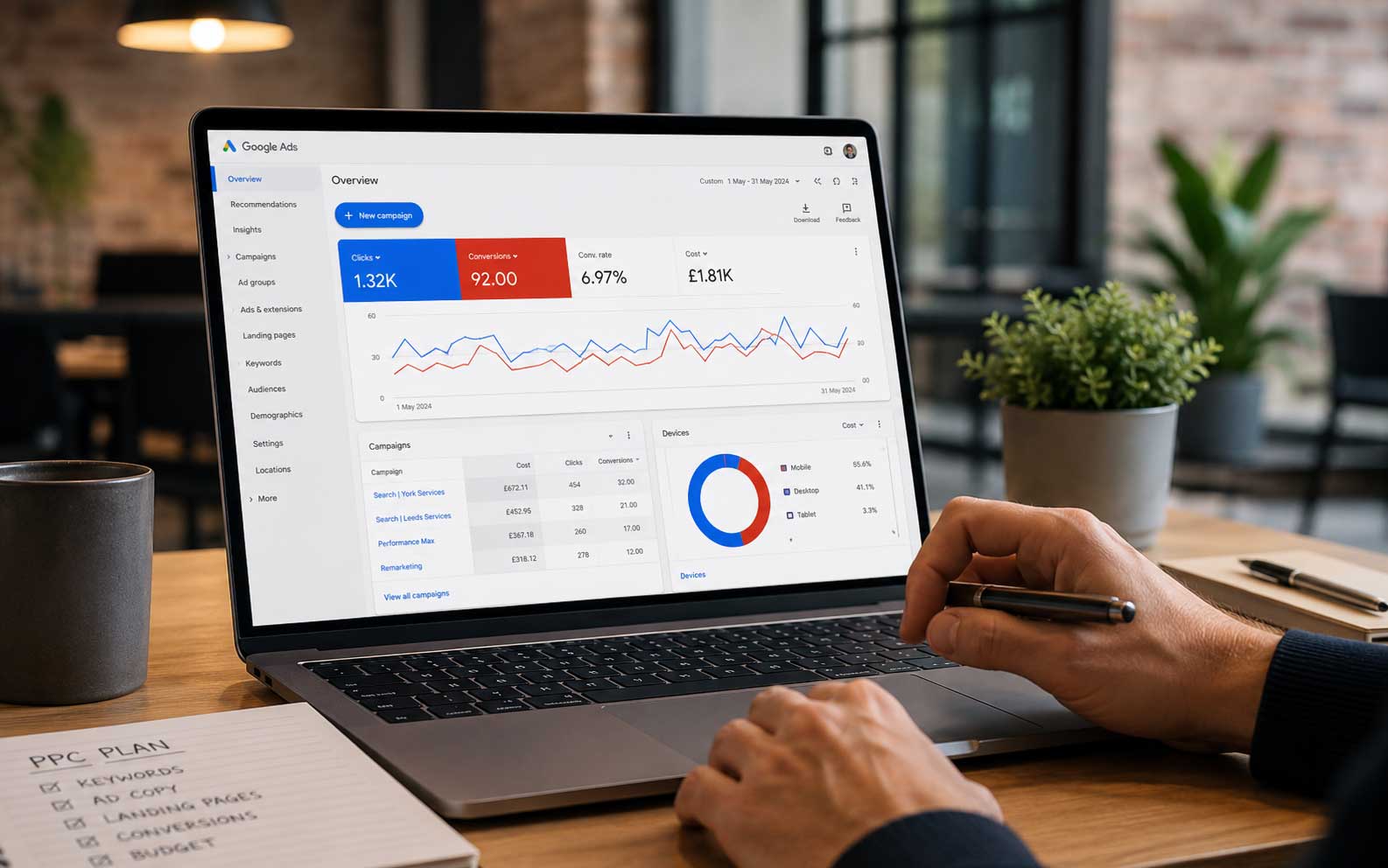
Unlike traditional advertising, every campaign can be measured. You can see exactly how many people clicked your advert, how many became customers and how much each enquiry cost.
Why many Google Ads campaigns fail
It’s surprisingly common for businesses to become frustrated with Google Ads after trying to manage campaigns themselves. In most cases, the platform isn’t the problem. The issue is that campaigns are often left running without the regular attention they need.
Some of the most common problems include:
- Choosing keywords that are too broad.
- Paying for irrelevant searches.
- Sending visitors to the homepage instead of a dedicated landing page.
- Weak advert copy that fails to stand out.
- No conversion tracking.
- Not reviewing search terms regularly.
- Missing opportunities to add negative keywords.
- Allowing underperforming adverts to continue running.
Even small improvements across these areas can significantly reduce wasted spend and improve the number of enquiries generated.
Every successful campaign starts with a clear strategy
Before launching any campaign, it’s important to understand what success looks like.
Some businesses want more telephone enquiries, while others are focused on online sales, quotation requests or appointment bookings. Defining those objectives from the outset makes it much easier to build campaigns that support real business goals.
A good PPC strategy considers:
- Your ideal customer.
- The areas you want to target.
- Your monthly advertising budget.
- Competitor activity.
- Seasonal demand.
- The services or products that generate the greatest return.
Rather than trying to advertise everything at once, it’s often more effective to concentrate on the services that provide the highest value to your business.
Choosing the right keywords
Keywords form the foundation of every PPC campaign. Selecting the right search terms helps your adverts appear when people are actively looking for what you offer.
Instead of targeting broad phrases with high competition, many businesses achieve better results by focusing on more specific searches that show stronger buying intent.
For example, someone searching for “Google Ads management for plumbers” is often much closer to making an enquiry than someone searching simply for “marketing”.
Successful keyword research also includes reviewing search intent, choosing the appropriate keyword match types and regularly adding negative keywords to prevent adverts appearing for irrelevant searches.
This ongoing refinement helps improve click quality while reducing unnecessary advertising costs.
Writing adverts that encourage clicks
Your advert has only a few seconds to capture attention.
The most effective adverts clearly explain what you offer, why someone should choose your business and what action they should take next.
Good advert copy usually includes:
- Clear, relevant headlines.
- Strong descriptions focused on customer benefits.
- Local references where appropriate.
- Relevant keywords.
- Ad extensions such as call buttons, location information and site links.
Rather than trying to attract everyone, the goal is to attract the right people—those who are most likely to become customers.
Your landing page is just as important as your advert
Generating clicks is only part of the process. Once someone visits your website, they need to find exactly what they were expecting.
A dedicated landing page generally performs far better than sending visitors to a generic homepage because it focuses on a single service or product.
An effective landing page should:
- Match the advert’s message.
- Load quickly.
- Be easy to use on mobile devices.
- Clearly explain your service.
- Build confidence with testimonials, reviews or examples of previous work.
- Include a simple contact form or obvious telephone number.
When the advert and landing page work together, conversion rates often improve significantly.
PPC campaigns need regular management
Google Ads isn’t something you can set up once and forget.
Markets change, competitors adjust their bids and customer search behaviour evolves throughout the year. Regular optimisation helps campaigns remain competitive while making the best use of your advertising budget.
Routine management should include:
- Reviewing search terms.
- Testing new advert variations.
- Monitoring keyword performance.
- Adjusting bids.
- Improving Quality Scores.
- Analysing conversion data.
- Pausing adverts that underperform.
- Reallocating budget towards campaigns producing the best results.
Small improvements made consistently often have a much greater impact than occasional major changes.
Measuring the results that actually matter
A campaign with thousands of clicks isn’t necessarily successful.
What matters is whether those clicks become genuine enquiries, sales or new customers.
That’s why effective PPC management focuses on metrics such as:
- Cost per enquiry.
- Conversion rate.
- Return on advertising spend.
- Telephone calls generated.
- Online enquiries.
- Revenue generated.
Tracking these figures provides a much clearer picture of campaign performance and helps guide future decisions.
PPC and SEO work best together
Many businesses see PPC and SEO as separate marketing channels, but they work particularly well when combined.
PPC provides immediate visibility while SEO builds long-term rankings and organic traffic. Running both together allows you to generate enquiries now while steadily improving your website’s presence in Google over time.
Search term data from PPC campaigns can also highlight opportunities for future SEO content, creating a more informed and effective digital marketing strategy.
Frequently Asked Questions
Is PPC suitable for small businesses?
Yes. One of the biggest advantages of Google Ads is that campaigns can be tailored to almost any budget. With the right management, even modest advertising budgets can generate worthwhile enquiries.
How much should I spend on Google Ads?
There isn’t a single answer. Your budget depends on your industry, competition and objectives. A well-managed campaign aims to maximise results regardless of budget by reducing wasted spend and focusing on high-quality traffic.
How quickly can PPC generate results?
Unlike SEO, PPC campaigns can begin attracting visitors as soon as they go live. Once campaigns are properly optimised, businesses often start generating enquiries within a relatively short period.
Can I advertise only in certain locations?
Absolutely. Google Ads allows campaigns to target specific towns, cities, counties or wider regions, helping ensure your adverts appear where your potential customers are located.
Is PPC better than SEO?
They serve different purposes. PPC provides immediate visibility, while SEO delivers sustainable long-term growth. Many businesses achieve the strongest results by investing in both as part of a wider digital marketing strategy.
Looking for PPC Management?
At Paragon Marketing, we manage Google Ads campaigns for businesses across York, North Yorkshire and throughout the UK. We focus on reducing wasted spend, improving campaign performance and generating genuine business enquiries rather than simply increasing clicks.
Whether you’re launching your first campaign or looking to improve an existing account, we can help you build a PPC strategy that delivers measurable results and better value from your advertising budget.